

 English
 España

How Long Does a Cordless Hand Mixer Battery Last? A Manufacturer’s Guide
 2026.10.30
 News
If you’re looking at a cordless hand mixer, the first question is often about battery run time. It’s also the one we hear most often as a manufacturer of rechargeable kitchen appliances. The short answer is that most cordless hand mixers give you between 20 and 40 minutes of actual mixing on a full charge. Some models are tuned for longer continuous use and can reach around 60 minutes. But the real-world number depends on what you’re mixing, how fast, and how well the battery has been maintained.
We’ve spent years building cordless hand mixers and other battery-powered kitchen tools, so let’s break down what battery life really means in the kitchen—and how to get the last drop of performance from yours.
What battery life should you expect from a cordless hand mixer?
Battery ratings are usually based on continuous, unloaded running, which is not how anyone actually mixes. In real kitchens, you stop to scrape bowls, add ingredients, and change speeds, so the usable time often feels longer than the continuous spec. That said, it helps to have a rough baseline.
| Task | Approximate runtime | Comments |
|---|---|---|
| Whipping cream | 20–35 minutes | High speed, light load |
| Mixing cake or cookie batter | 20–40 minutes | Medium load, includes pauses |
| Mashing potatoes | 15–25 minutes | Heavier load at medium speed |
| Kneading dough | 10–20 minutes | Maximum load, use with care |
These numbers are typical of the lithium-ion packs used in most current cordless models. The more demanding the task, the faster the battery drains.
What affects cordless hand mixer battery life?
Battery life is not one fixed number. Several variables determine whether you get closer to 15 minutes or closer to an hour.
1. Battery capacity and chemistry
Higher-capacity batteries store more energy, so a 3000 mAh pack will naturally outlast a 1500 mAh pack under the same workload. Lithium-ion is the standard chemistry today because it offers high energy density, low self-discharge, and reliable recharging.
2. Speed setting and workload
Higher speeds and thicker mixtures pull more current. A light job like whipping a small carton of cream uses noticeably less power than mixing stiff dough. This is why manufacturers rate runtime at “no-load” or describe it as “up to” a certain number of minutes.
3. Temperature and charging habits
Extreme heat or cold can temporarily reduce battery performance. Charging at room temperature and storing the mixer in a dry place helps preserve capacity. Leaving the battery fully discharged for a long time can also shorten its usable life.
4. Age and maintenance
Every rechargeable battery loses a little capacity over time. After a few hundred charge cycles, you may notice that the mixer runs out sooner than it did when new. Keeping contacts clean and avoiding deep discharges can slow that natural decline.
How to estimate runtime from battery specs
If you want to compare models, look at the battery’s watt-hour (Wh) rating rather than only the milliamp-hour (mAh) label. The watt-hour number combines voltage and capacity, giving a better sense of total energy. Divide that by the mixer’s average power draw in watts, and you get a rough runtime in hours.
For example, a 20 Wh battery feeding a mixer that averages 30 W would provide about 0.67 hours, or 40 minutes. Most household mixes take only a few minutes, so a full charge is usually enough for several batches before the mixer needs to go back on the charger.
How to get the most from your cordless mixer battery
- Charge fully before a big baking session; partial charges are fine, but a full charge gives you the clearest runtime picture.
- Let the mixer rest for a minute after sustained high-speed mixing; this also helps the motor and battery stay cool.
- Use the lowest speed that gets the job done. It is easier on the battery and often produces better texture.
- Store the mixer in a cool, dry place, and avoid leaving it in direct sunlight or near a hot oven.
- Recharge at least every two or three months if you do not use it regularly, so the battery stays healthy.
- Keep the battery contacts and the area around them free of dust and grease.
None of these steps require special tools. They are simply habits that help rechargeable batteries age gracefully.
What we’ve learned designing cordless hand mixers
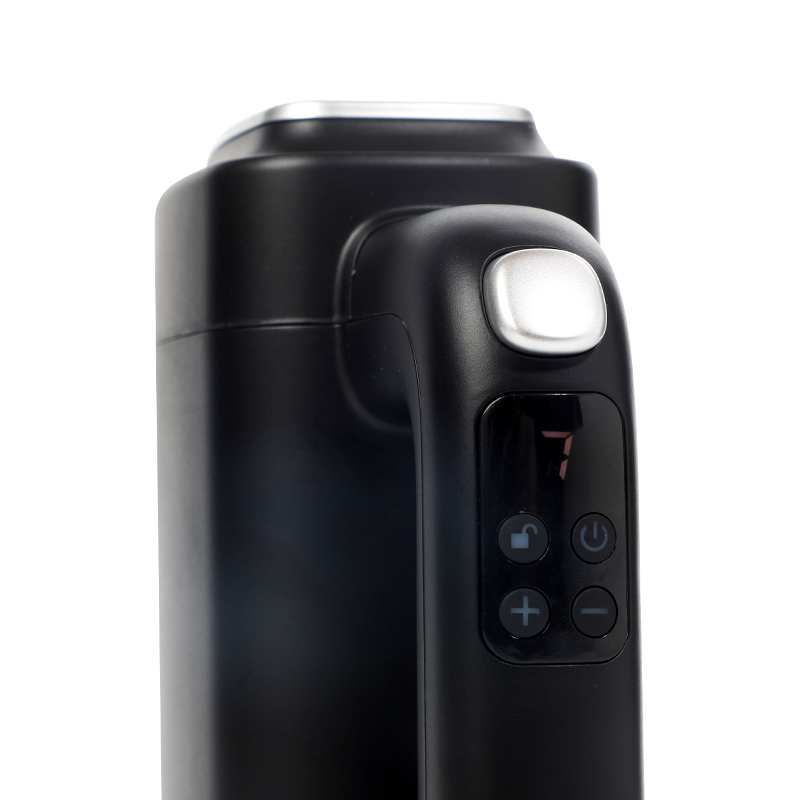
As a company that builds battery-powered kitchen appliances, we test mixers on real batters, creams, and vegetable purees, not just on a bench with no load. That testing philosophy shapes how we think about battery life. We want the charge to last through the tasks people actually do—whipping eggs, blending a smoothie, folding batter—without forcing you to rush.
Our approach to production and quality control is built around that goal. Our quality process explains why we put so much focus on reliable batteries and motors before a product reaches your hands.
When is it time to replace the battery?
If your mixer runs for less time than it used to, charges unusually quickly, or dies suddenly under a light load, the battery is probably nearing the end of its cycle life. That is normal for any lithium-ion product. Some cordless hand mixers have replaceable packs; others are sealed units. If your model has a removable battery, replacing it can give the mixer a second life.
The bottom line on cordless hand mixer battery life
Plan on 20 to 40 minutes of steady mixing per charge for most cordless hand mixers, with higher-capacity models able to push closer to an hour. Your actual runtime will vary based on battery capacity, speed, load, and how old the pack is. Choose a model with enough capacity for your typical baking tasks, take reasonable care of the battery, and a cordless hand mixer can be one of the most convenient tools in your kitchen.
PREV: Portable Food Chopper Guide: Cordless Convenience for Everyday Kitchen Prep
NEXT:It is the last article
NEXT:It is the last article
 SEE more
 SEE more
 SEE more
 SEE more
 SEE more
 SEE more
 SEE more
 SEE more
 SEE more
 SEE more
 SEE more
 SEE more
 SEE more
 Leave a message
Copyright © Ningbo Longde Life Electric Appliance Co., Ltd.  Wholesale Portable Kitchen Appliance For Outdoor Use Manufacturers