

 English
 España
News
Home / News / Industry News / Why Is Everyone Buying a Portable Food Chopper Instead of a Food Processor

Why Is Everyone Buying a Portable Food Chopper Instead of a Food Processor
 2026.02.17
 Industry News
Modern Kitchen Dilemma: Efficiency vs. Space
In today's fast-paced life, the kitchen is no longer just a place for cooking, but a battleground between efficiency and quality of life. With the acceleration of urbanization, the tightening of living spaces—especially kitchen spaces—has caused bulky appliances to lose their former appeal. People are seeking solutions that can handle tedious prep work without occupying excessive counter space. Against this backdrop, the Portable Food Chopper has emerged and quickly become a favorite in modern kitchens.
For most home cooks, chopping onions, mincing garlic, or dicing chilies is the most tedious part of cooking—it is time-consuming, leaves unpleasant odors on hands, and often causes tears. Traditional large food processors are powerful, but their complex assembly and cumbersome cleaning often deter users who only need to prepare small amounts of ingredients. The Portable Food Chopper perfectly fills the gap between manual knife work and industrial-scale processing.
The charm of this device lies in its "subtraction philosophy." It discards redundant wires (for wireless models) and heavy bases, pursuing extreme portability and focus. Whether in a studio apartment or at an outdoor camping table, a Portable Food Chopper provides efficient cutting power anytime, anywhere. It is not just a tool, but a symbol of a minimalist and efficient lifestyle.
Core Parameter Comparison
| Feature | Portable Food Chopper | Full-Size Food Processor | Manual Chopper |
| Power Source | Lithium Battery (USB) or Low Power Motor | AC Power Outlet | Manual Labor |
| Rated Power | 30W - 100W | 500W - 1200W | N/A |
| Capacity | 100ml - 350ml | 1.5L - 4L | 200ml - 500ml |
| Portability | Extremely High | Low (Heavy) | High |
| Primary Use | Garlic, Ginger, Chili, Baby Food | Dough, Slicing, Large Meat Batches | Coarse Veggie Chopping |
| Cleaning Ease | Extremely Easy | Difficult | Moderate |
Deep Dive: Multiple Advantages of the Portable Food Chopper
The Portable Food Chopper offers incomparable convenience when solving specific culinary "pain points."
Revolutionizing Prep Efficiency
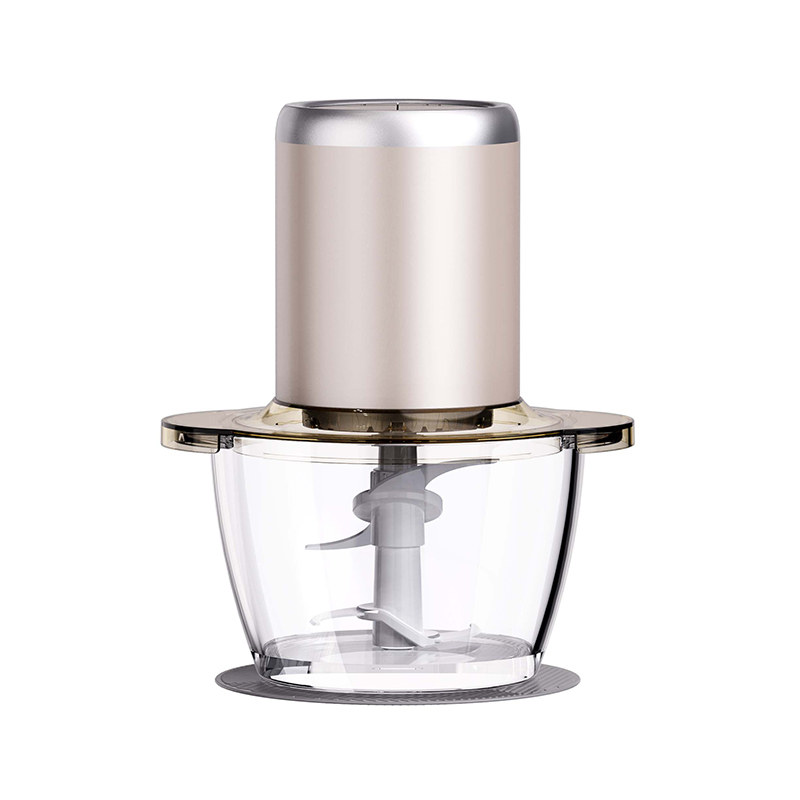
In traditional cooking, processing small amounts of aromatics is often the most time-consuming step. The Portable Food Chopper simplifies this: just toss ingredient chunks into the container, close the lid, and press the button. In just 5 to 10 seconds, your ingredients are processed into granules or paste.
Efficiency Comparison Table
| Ingredient (50g) | Manual Chopping Time | Portable Food Chopper Time | Consistency |
| Garlic | Approx. 120s | 5 - 8s | Extremely High |
| Onion | Approx. 90s | 5 - 10s | High |
| Dry Nuts | Approx. 150s | 8 - 12s | Medium |
| Fresh Chili | Approx. 60s | 5 - 7s | Extremely High |
The Expert in Small Portions
Large processors often have a "blind spot" where small amounts of ingredients stick to the walls and escape the blades. The compact structure of the Portable Food Chopper ensures tight contact between the blades and the ingredients, even for tiny amounts.
Ultimate Cleaning Experience
The structure is usually simplified into four parts: motor base, blades, container, and lid. Most residues can be removed simply by rinsing under a tap for 30 seconds. This "burden-free" feeling is a key reason for its high-frequency use.
Performance Watershed: Mini Chopper vs. Full-Size Food Processor
Understanding the "capability boundaries" of a Portable Food Chopper is crucial.
Core Difference: Pulse Control vs. Continuous Power
The Portable Food Chopper utilizes high-frequency pulse design. Its micro DC motor excels at short bursts of speed but is not suitable for long-term continuous operation. Full-size processors use heavy-duty motors for minutes of kneading or blending.
Task Capability Comparison
| Kitchen Task | Portable Food Chopper | Full-Size Food Processor |
| Small Aromatics | Winner: No dead zones | Disadvantage: Sticks to walls |
| Kneading Dough | Incapable | Winner: High Torque |
| Slicing/Shredding | No such function | Winner: Multiple discs |
| Liquid Emulsifying | Moderate | Winner: Feed tube support |
Technical Parameter Comparison
| Technical Metric | Portable Food Chopper Value | Full-Size Processor Value |
| Rated Voltage | 3.7V - 7.4V (Lithium) | 110V - 220V (AC) |
| Blade Speed | 15,000 - 20,000 RPM | 1,500 - 2,500 RPM |
| Work Time | 30 seconds or less | 3 - 5 minutes |
Buying Guide: The Secrets Behind Hardware Specs
Blade Material: 304 or 420?
The blade is the heart of the device. Most products use either 304 or 420 stainless steel.
| Material Type | Core Advantage | Best Use Case |
| 304 Stainless | Excellent corrosion resistance | Juicy fruits and vegetables |
| 420 Stainless | High Hardness, very sharp | Recommended: Nuts or meats |
Power Management
For wireless Portable Food Chopper models, battery determines runtime and burst power. Look for 1200mAh - 2000mAh capacities and USB-C interfaces for stability.
Container Material: Glass vs. Plastic
| Container Material | Pros | Cons |
| Borosilicate Glass | Odor-resistant, heat-resistant | Heavy, fragile |
| PCTG/AS Plastic | Lightweight, drop-resistant | Prone to staining |
Ideal Scenarios: Who Needs a Portable Food Chopper?
Baby Food Preparation
For infants starting solids, food needs to be extremely fine. The 100ml-250ml capacity of a Portable Food Chopper is perfect for single-meal fresh purees.
Fitness Enthusiasts
Prep a week's worth of minced garlic and ginger for seasoning in seconds and store them in jars to save daily cleanup time.
Performance Adaptation Table
| User Group | Focus Point | Recommended Spec |
| Parents | Material Safety | 3-blade + Glass bowl |
| Fitness/Dieters | Efficiency | 420 Steel + Fast Charge |
| Campers | Weight | PCTG Plastic + Magnetic lock |
Practical Tips: Advanced Skills
The Pulse Technique
Do not hold the button down continuously! Press for 1-2 seconds, release, and repeat. This allows ingredients to settle and ensures a uniform chop rather than a paste.
Loading Principles
| Principle | Action | Purpose |
| Volume Control | Fill 50% - 70% | Allows for cyclone effect |
| Hardness Layering | Hard items at bottom | Bottom blades hit heavy items first |
| Moisture Control | Ensure herbs are dry | Prevents leaves from sticking |
Maintenance and Longevity
Battery Health
Avoid deep discharge. Charge your Portable Food Chopper when you feel the rotation slowing down (approx. 20% battery). Keep the battery at 50% - 80% if not using for long periods.
The Waterproof Myth
| Component | Cleaning Method | Risk Warning |
| Motor Base | Wipe with damp cloth | Never soak in water |
| Blade Assembly | Brush and dry immediately | Prevents odors in the axis |
| Container | Normal washing | High-temp may cloud plastic |
FAQ: Hot Questions and Knowledge
Q: Why does my Portable Food Chopper not respond after charging? A: Check if the magnetic lock is aligned. Most models have an auto-cut circuit if the lid isn't tightened or aligned with the markings.
Q: Can it mince raw meat? A: Yes, provided the meat is de-sinewed, cut into 1.5cm cubes, and the bowl is only half full. Use pulses to prevent overheating.
Q: Can I sharpen the blades myself? A: Not recommended. The blades are thin and set at specific angles; manual sharpening can unbalance them.
Q: Glass vs. Plastic: Which is more durable? A: Borosilicate glass is best for home use due to hygiene; PCTG plastic is better for travel and baby food due to impact resistance.
Q: Can it handle extremely hard objects like ice? A: Most portable models do not support this. Ice exceeds the torque limits of micro DC motors and can damage the blades.
 SEE more
 SEE more
 SEE more
 SEE more
 SEE more
 SEE more
 SEE more
 SEE more
 SEE more
 SEE more
 SEE more
 SEE more
 SEE more
 Leave a message
Copyright © Ningbo Longde Life Electric Appliance Co., Ltd.  Wholesale Portable Kitchen Appliance For Outdoor Use Manufacturers